
-

Email

A generator speed governor is a control device that keeps the engine running at a constant speed, whatever the electrical load. Because generator frequency depends directly on engine speed, a steady governor means steady frequency (50 Hz or 60 Hz). An electronic governor reads engine speed from a magnetic pickup, compares it with the set speed, and adjusts an actuator that controls fuel, correcting speed changes within a fraction of a second.
Key takeaways
An electronic governor is a closed loop control system and consists of three parts:
When load increases, the engine slows slightly. The controller sees the drop, sends more current to the actuator, fuel increases, and speed returns to the set point. When load drops, the same loop reduces fuel to stop the engine over-speeding. Many controllers use PID (proportional, integral, derivative) control, with separate gain and stability adjustments to tune how fast and how smoothly the engine responds.
| Feature | Electronic governor | Mechanical governor |
|---|---|---|
| How it senses speed | Magnetic pickup and electronics | Flyweights and springs on the engine |
| Response to load change | Fast, tunable (gain, stability) | Slower, fixed by mechanical design |
| Adjustment | Potentiometers or DIP switches | Mechanical adjustment on the engine |
| Isochronous operation | Yes, widely supported | Limited |
| Droop and paralleling | Adjustable droop, remote speed trim | Fixed droop characteristic |
| Wear | No wearing mechanical parts in the controller | Moving parts can wear |
| Best for | Standby power, paralleling, strict frequency | Simple, low-cost sets |
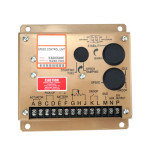
Both types are available on the Speed Governor page, for example the electronic ESC9800 and the mechanical EG2000.
Some units, such as the ESD2210-12, can run in either mode. If you run generators in parallel, also look at load-sharing and synchronizer modules such as the SYC6714.
| Model | Supply voltage | Actuator / output current | Speed sensor signal | Stability |
|---|---|---|---|---|
| ESC9800 | 12 V or 24 V DC | See product page | 0.5–120 V RMS | Better than ±0.25% |
| EFC 3098693 | 12 V or 24 V | 1 A min to 4.5 A max (continuous) | 2–120 V RMS | Better than ±0.25% |
| Fortrust C1000A | 12–32 VDC | 0–5 A | 0.5–120 V RMS | ±0.25% |
| EG3000 | 12 or 24 VDC (±20%) | 0.5–15 A | 1–120 VAC RMS | ±0.25% steady state |
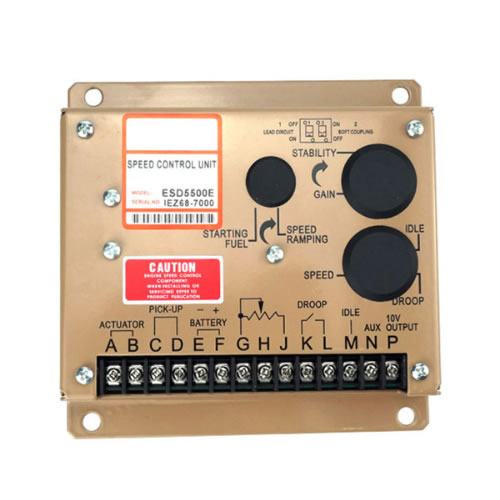
| ESD5500E | 12 or 24 VDC | Up to 10 A | See product page | ±0.25% |
Specifications are from the HXL product pages. Always confirm the full data sheet and your actuator's current rating before ordering. For a deep dive on one model, read our ESD5500E guide.
Work through this checklist before you order:
Fast shortcut: Send us a photo of your old controller and your engine or actuator model, and we will confirm the right replacement.
Many controllers let you tune this with the gain and stability potentiometers. Make small changes and test with a step load after each one.
The governor controls engine speed, which sets frequency. The AVR controls excitation, which sets voltage. If speed drops, frequency falls and the AVR's under-frequency roll-off lowers the voltage to protect the alternator. That is why unstable voltage is sometimes a speed problem, not an AVR problem. Before replacing parts, read our guide on why a generator AVR stops working and how to select the right AVR. Browse the full AVR range alongside your governor order.
HXL Generators & Parts Co., Ltd. supplies electronic and mechanical speed governors for diesel generators, with custom sizes and free sample support so you can test fit before a bulk order.
Send your engine model, actuator model, supply voltage and old controller number, and we will reply with the matching governor, price and lead time.
It keeps the engine at a constant speed by adjusting fuel as the load changes. Constant speed gives constant frequency.
An electronic governor uses a magnetic pickup, a controller and an actuator and can be tuned for fast, precise response. A mechanical governor uses flyweights and springs on the engine and has a simpler, fixed response.
Isochronous mode holds speed constant at any load and suits a single generator. Droop mode lets speed fall slightly with load so that generators in parallel can share load.
No, the controller must match the actuator type, the actuator's current demand, your supply voltage and the speed sensor signal. Check the product page or send us your details.
Hunting usually means the gain or stability setting needs adjusting, but it can also come from a worn actuator, loose wiring or a poor speed sensor signal.
Yes, if the engine runs slow, frequency drops and the AVR's under-frequency roll-off reduces output voltage.
Yes, we offer free sample support and custom sizes. Send your engine and actuator details to get started.