
-

Email

News Date:
2026-11-25Item NO.:
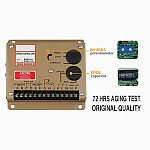
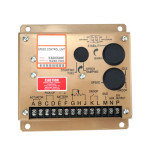
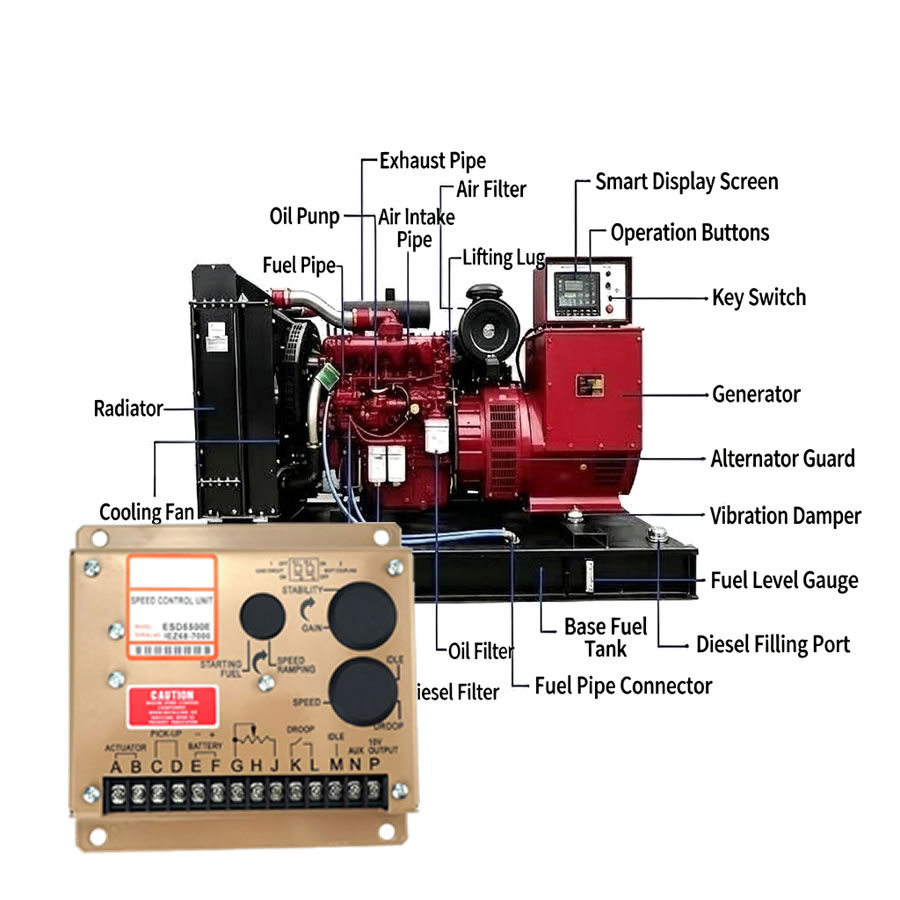
Working Principle Of The Speed Controller And Diesel Generator Setwhen a power outage hits a factory, this machine suddenly springs to life—but where does all that power—hundreds of kilowatts—come from? How does it manage to go from a complete standstill to full-power output in under 30 seconds? Today, we’ll take it apart to show you how a generator set converts diesel fuel into stable, three-phase electricity. A diesel engine burns fuel to produce rotational mechanical energy, but the power grid requires 50Hz alternating current (AC). Bridging the two is a main shaft: one end is connected to the diesel engine’s crankshaft, while the other is attached to the generator’s rotor. Surrounding the rotor are the stator coils. The rotor itself acts as an electromagnet; as it spins at high speed within the stator coils, each full rotation induces a sinusoidal voltage waveform in the coils. A frequency of 50Hz means the rotor must complete 50 revolutions per second—or 3,000 revolutions per minute (RPM)—requiring the diesel engine to maintain this speed with precise stability. Here’s the challenge: the moment a load is applied, the current surges, causing an immediate, sharp spike in the electromagnetic resistance acting on the rotor—which threatens to drag down its rotational speed. This is where the governor steps in. It continuously monitors the speed; the instant it drops below 3,000 RPM, the system increases the diesel engine’s fuel injection, generating greater combustion torque to push the speed back up. The entire response—from zero load to full power—occurs in under 0.2 seconds, with frequency fluctuations kept within 2.5 Hz. Powering the rotor itself is somewhat counterintuitive: since the rotor spins at high speed, it cannot be connected via fixed wiring. Instead, power is delivered through carbon brushes that make contact with slip rings mounted on the shaft. These carbon brushes are wear components, requiring replacement every 2,000 hours of operation. Even more intriguing is that the rotor coils are supplied with direct current (DC) from a dedicated, small-scale exciter—a miniature generator attached to the end of the main shaft that rotates in tandem with it. Through a closed-loop process—involving diesel combustion, crankshaft rotation, electromagnetic induction, and speed regulation—the system achieves a stable, three-phase 380V AC output, locked at a frequency of 50 Hz. This is the complete chain by which a generator set converts chemical energy into electrical energy on demand.
If you have stone inquiry, please leave us a message, we will reply you as soon as we can!