
-

Email

News Date:
2026-10-16Item NO.:
Generator AVR Not Working Common Causes & FixesWhy does your generator start without a fuss, sound perfectly healthy, and still leave the voltmeter stuck at zero or jumping all over the place? When it happens in the middle of a busy shift, every minute feels long, and many people face the same confusing moment. A lot of the time, the cause is a generator AVR not working the way it should. The part is small, but it decides whether your engine's effort turns into steady, usable power.
Let's walk through what the generator AVR does, how it fails, and how you can fix the trouble without losing days.
Your AVR keeps reading the output voltage and adjusts the power sent to the alternator field, so the voltage stays steady as the load changes. When it slips, you get generator voltage fluctuations that your equipment feels first.
Trouble usually shows up before the generator gives up completely. Spotting the signs early protects your equipment and your schedule.
The cause is rarely dramatic, and a small issue that builds over time is far more common. These are the generator AVR problems worth checking first.
Vibration loosens connections, and a weak sensing or field wire can make output drop or swing.
A regulator inside a hot, dusty, or damp panel ages faster, and burnt spots on the board give it away.
Low or hunting rpm drags voltage down even when the AVR is healthy.
Running far above rated load keeps the regulator working hard and shortens its life.
A regulator with the wrong sensing voltage or jumper setup can give high, low, or zero output.
Many owners blame a generator AVR that is not working when the real fault sits in the wiring or engine speed. Switch off the generator and isolate the load before you touch any wiring.
Say the lights in your workshop dim whenever the welders start. If a generator AVR not working is behind it, the pattern tells you where to look first.
Check engine speed and load first, then tighten the sensing wires. If the dip happens only when big motors start, the engine may be struggling more than the regulator.
Inspect the wiring that feeds the AVR, then try a known good unit before blaming the alternator.
Recheck the sensing connection and settings, because a poor sensing signal can push output up.
Buying the wrong part turns one problem into two. Matching a few details first keeps that from happening.
Is your generator AVR not working, or is something else causing the trouble? This table matches each sign with its likely cause and first step.
| What You See | Likely Cause | First Step |
|---|---|---|
| Voltage swings up and down | Unsteady engine speed or loose sensing wire | Check rpm, tighten connections |
| No voltage, engine running | Failed AVR or broken field wiring | Inspect wiring, then swap AVR |
| Voltage too high | Poor sensing signal or wrong settings | Recheck sensing wires and jumpers |
| Voltage drops under load | Overload or low engine speed | Reduce load, check rpm |
| Burnt smell near regulator | Heat, dust, or moisture damage | Shut down and replace AVR |
| New AVR still misbehaves | Wrong model or settings | Match model, sensing voltage, jumpers |
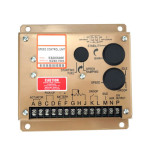
A matched regulator and a steady engine work best as a team. If your engine speed drifts too, a speed governor such as our ESD5500E holds speed within plus or minus 0.25% on 12 or 24 VDC systems. Don't let a generator AVR not working keep your site waiting. Send your model details through our contact page, ask for a free sample, and we'll help you find the right fit. Bulk orders usually take 12 to 15 days.
Watch for swinging voltage, flickering lights, output far above or below the rating, or a burnt smell near the board. A swap test with a known working unit of the same model gives the clearest answer.
A failed regulator is a common reason, though broken field wiring can cause the same thing. Check the wiring first, then test or swap the AVR.
Only if the sensing voltage, jumper options, and field output suit your alternator. Send us your alternator details and ask for a free sample to confirm the fit.
Yes, it can, because voltage drops along with engine speed when the engine runs slow or hunts, and a regulator can't fully make up for that. Check the engine's speed control as well.
If you have stone inquiry, please leave us a message, we will reply you as soon as we can!